

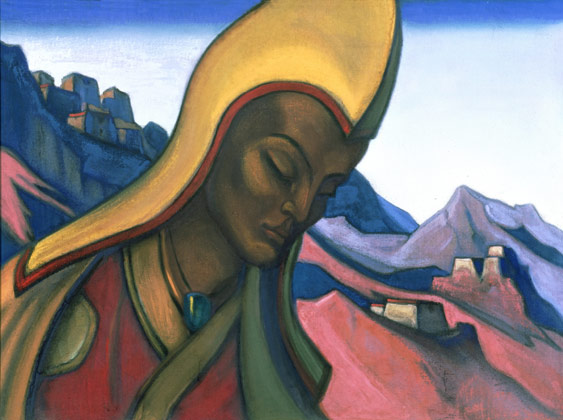
Painting by Nicolas Roerich
By Cyrus Ryan
What Is Samadhi – Entering Higher States of Consciousness
Samadhi is described as a state in which individual consciousness is completely withdrawn from the physical body and the five senses. There is no awareness of the physical form whatsoever. Cyrus emphasized that this total separation from the body is the defining characteristic of genuine Samadhi, distinguishing it from deep concentration (Dharana) or meditative absorption (Dhyana), in which some bodily awareness remains.
To illustrate this, Cyrus read two accounts from Indian spiritual literature. The first, from Chapter 14 of Autobiography of a Yogi, describes Yogananda’s experience when his guru Sri Yukteswar struck him gently on the chest. Yogananda’s breath was drawn out, his soul and mind streamed out as fluid light from every pore, and his sense of identity expanded to encompass the surrounding environment – trees, streets, people – in a vast spherical awareness. All objects eventually dissolved into a luminescent sea, and he experienced an oceanic joy.
The second account, from Ramakrishna and His Disciples by Christopher Isherwood, describes the young Naren (later Vivekananda), aged 18, being touched by Ramakrishna’s foot. Naren experienced the room whirling and receding, his sense of self dissolving into a vast void, which he described as feeling like death. He cried out in fear, and Ramakrishna withdrew the experience. Cyrus also read Ramakrishna’s own visionary account of ascending through planes of consciousness, passing a fence of light separating the divisible from the indivisible, and beholding seven sages made of pure consciousness – one of whom he recognized as Naren, an eternal companion destined to descend to earth with him.
Two shorter accounts from Chinese Chan master Hanshan were also presented. In the first, Hanshan entered Samadhi while standing after a meal, experienced a great brightness containing all mountains, rivers, and the earth, and composed a verse upon returning. In the second, he entered Samadhi in which space and time were void, the ocean emitted light, and mountains and rivers shook; upon awakening, he wrote continuously through the night, completing a commentary on the Surangama Sutra.
Relevant Q&A
Question (Alan S.): Are they being pushed out of their physical body when the master touches them?
Answer (Cyrus): No – they are being pulled into Samadhi. According to Master DK’s teaching, when a disciple reaches the level of Sonship of the Master, they enter into the consciousness of the master. Yogananda and Naren were having their experiences by sharing the consciousness of their masters – Sri Yukteswar and Ramakrishna respectively – drawn into Samadhi by the occult power of these advanced beings. Hanshan, by contrast, was practicing Samadhi independently, having meditated almost continuously for years.
The Stages of Samadhi – Laya Points, Sabija, and Nirbija
Cyrus used a whiteboard diagram and the analogy of a jet breaking the sound barrier to explain the mechanics of entering Samadhi. Just as a jet passes through a barrier of vapor at Mach 1, consciousness passes through a Laya Point – a barrier between planes – to enter Samadhi. This Laya Point is also called the Bindu, described as the common center in which all vehicles of the Jiva Atma are centered, enabling transference of consciousness to higher planes.
The first level entered is called Samprajnata Samadhi (Sabija – with seed/form). In this state, there is still a seed or object of focus – a flame, a deity, a symbol, or a master. The yogi’s consciousness passes through the Laya Point and enters a higher plane while still retaining some relationship to form. There are approximately five progressive levels of Samprajnata Samadhi, each separated by another Laya Point (Asamprajnata – a momentary void between levels). Each passage corresponds to a higher plane on the Atmavidya diagram: the Manomaya Kosha, Vijnanamaya Kosha, Anandamaya Kosha, and beyond.
Eventually, passing through the final barrier leads to Nirbija Samadhi – without seed, without form – associated with the Buddhic and Akashic planes, where one experiences the totality of existence as an ocean of light, as described in Yogananda’s account.
Cyrus also explained that between each chakra in the human energy system, there exists a Laya Point. These points serve as protective separations that keep ordinary consciousness grounded. When these points are damaged (as in certain mental illnesses), the astral plane floods in uncontrollably. In Samadhi, the meditator passes through these points in an orderly, protected way – typically through the grace of a higher being at the aspirant’s current stage.
Relevant Q&A
Question (Stephanie): Is the central channel you mentioned the same as the Sushumna, between the Pingala and Ida?
Answer (Cyrus): Yes, in a certain respect. In his own Samadhi experience, Cyrus felt himself pass out through the top of the head and return through it, which relates to the Sushumna channel.
Question (Stephanie): Would each plane on the Atmavidya correspond to each level of Samadhi or Bindu portal?
Answer (Cyrus): Yes. The book maps the Manomaya Kosha, Vijnanamaya Kosha, and Anandamaya Kosha to progressively higher levels of Samprajnata Samadhi, culminating in Nirbija Samadhi at the formless planes.
Question (Alan S.): Is the flame the seed for Samprajnata Samadhi at our current stage?
Answer (Cyrus): Yes. The seed can be any form – a flame, a deity, a Buddha, a master, a symbol. Cyrus uses the flame because it is familiar to the group and easy to draw. In his own first Samadhi, the seed was a radiant sun, guided by a being of light whose eyes directed his consciousness forward until he entered the sun and passed through into another world.
Question (Khet): Is the Laya Point a point of fusion, like the flame drawing closer?
Answer (Cyrus): The Laya Point is an ancient concept from the Yoga Sutras, thousands of years old. The jet analogy is modern – the sound barrier was only photographed in the 1940s-50s. The Laya Point between the meditator and the object is the barrier through which consciousness passes; the fusion of seer and object in Dhyana is the approach to that barrier.
Samskaras, Mystical vs. Esoteric Experience, and the Path of Practice
Cyrus explained that the permanent atoms – subtle vehicles carried across lifetimes – contain all samskaras (impressions from past lives). When a meditator begins to access higher planes, they encounter these samskaras, which can condition or blur the Samadhi experience. Until sufficient purification is achieved, even in Samadhi, samskaras can prevent the full experience of reality. A third-degree initiate or advanced second-degree initiate still has active samskaras, whereas a more enlightened being who has gone beyond the permanent atoms will have a far clearer experience.
Cyrus drew a distinction between mystical experiences and genuine esoteric Samadhi. Mystical experiences – beatific visions, feelings of stillness, peaceful states, visual phenomena – are valid and often reflect past-life meditation practice. However, they do not necessarily yield real esoteric knowledge. Genuine Samadhi transforms the being of the practitioner and provides direct, non-intellectual knowledge of spiritual realities. Cyrus noted that he himself passed through many years of mystical experience before entering esoteric stages, and that the onset of hindrances and difficulties in meditation can actually signal the beginning of genuine esoteric development.
The practical path for participants at the current stage involves working on Pratyahara (withdrawal of consciousness to a center of awareness), then Dharana (yogic concentration – creating a focused channel between the meditator and the seed), and then Dhyana (deepening fusion, shortening the distance between seer and object). Samyama – the ability to enter Samadhi at will – is the advanced stage, accessible only to highly purified, near-enlightened beings such as Ramakrishna, who could enter Samadhi spontaneously upon hearing a beautiful song or seeing a sunset.
Relevant Q&A
Question (Celio): Samadhi appears to be a static state of joy and high consciousness, not an active working state. How does it relate to the great work to be done?
Answer (Cyrus): Samadhi is not merely passive. Through higher experiences, the practitioner gains real knowledge – not intellectual book learning, but knowledge known in one’s being. This transforms the quality of one’s words and actions, enabling one to help and affect others. Both Vivekananda and Yogananda had their Samadhi experiences young and went on to do great works in the world. Hanshan not only performed miracles but helped China through his wisdom. Some masters work on the inner planes in ways largely invisible to us; others, like Yogananda, work directly with the masses.
Question (Stephanie): Is touching the void a level of Samadhi?
Answer (Cyrus): It depends on the experience. The key criterion is whether there is any remaining sensation of the physical body or senses. If one is fully within the void as a single point of consciousness with no bodily awareness, that would qualify as a type of Samadhi. If one senses the void from outside while still aware of the body, it is more likely advanced Dharana or Dhyana – or a samskara-triggered memory of a past experience of the void.
Question (Stephanie): What is the advice for someone on the threshold of the void who feels the pull but also feels fear?
Answer (Cyrus): Let go and have faith. The fear arises because the ego-self does not want to surrender its sense of identity – in the void, there is no personal self. Like the pilot Yeager breaking the sound barrier, one must hold on with faith and surrender thought. At the current stage, Samadhi cannot be willed; it happens through grace. Visualizing the void or a symbol is not harmful, but caution is warranted because the formless void offers no protective form; a deity or symbol as seed provides protection.
Question (Prashant): What is the difference between mystical stillness and genuine esoteric experience, and how does one move beyond mystical experience?
Answer (Cyrus): Mystical stillness is pleasant and relaxing, and often reflects past-life meditation, but it does not necessarily create a center of awareness or yield esoteric knowledge. The path forward is to establish Pratyahara – a genuine center of awareness – and then create a point of tension between that center and the seed object, as described in the Yoga Sutras and the Tibetan Master’s teachings. The onset of hindrances and drowsiness in meditation, rather than being negative, can signal that the esoteric path is beginning to have effect, awakening deeper layers of the being.
Question (Khet): How does the sense of time change in deep meditation and Samadhi?
Answer (Cyrus): In higher states of consciousness, one enters a different cycle or flow of time. Hanshan did not know how long he had been in Samadhi until he saw dust on his rice pot. A story from Milarepa’s teaching describes a 16-year-old student who sat in Samadhi for five days, believing only a short time had passed. Even in deep meditation, participants may notice that what felt like 20-30 minutes was actually 40 minutes or more.
The above is created by AI from our zoom online group meeting: Esoteric Talks.